Writing Assignment #1 – Personal Statement for why I want to do the MD-PhD Program
I find the human body to be very interesting because it has many capabilities, which include its ability to heal itself from injury, defend itself, and produce certain substances when needed, similar to a chemical factory. I want to become an MD-PhD research doctor because I want to be able harness the abilities of the body to help produce groundbreaking advancements in medicine. It is very fascinating that there is an average of 30 trillion cells and 200 different types of cells that work together make up one human body and keep it alive. I want to research the stem cells in our body to be able make new organs. Research regarding this particular topic has already begun, and primitive human organs and organoids have already been made with stem cells. I want to be able join this research and help make real organs.
Last fall, I started out at ODU as a incoming freshman, and I will be a sophomore this August. My job shadowing experiences that I have gained in my high school years and in my first year of college have really solidified for me that medicine research is what I want to pursue. I have seen lots of patients that were very ill from cancer and I think that research and development in immunotherapy might give some of these patients a chance to get better. Immunotherapy has also really advanced in recent years, but it still faces setbacks by causing myocarditis (inflammation of heart muscle) cells in certain patients by attacking heart cells instead of the tumor. Learning more about why this happens and preventing this from happening is an important part of the job that I am pursuing in the future.
The more we learn about the human body, the more we find out that there are things we need to learn more about. As a person who finds researching the human body to be very captivating, there will be no shortage of problems and topics that I like to research. I believe that I am a good candidate to able to do an MD-PhD program because I have the work ethic required to be successful in rigorous programs like this. I also feel lots of compassion towards people, so I will not quit in making patients feel better because I genuinely want to see them get better. In conclusion, you will not regret getting me in your MD-PhD program.
Writing Assignment #2 – Primary and Review Articles
The first and original articles that describe new findings of scientific research. They have multiple parts which include, but, are limited to: Introduction, Methods, Results, Discussion, and References. They also contain advanced niche vocuabulary and have keywords like “remains to be verified” and “we detected.” In these kinds of articles, charts and tables are utilized to show data from the research. Last but not least, experts in the field also check the work to be published for accuracy and scientific integrity.
There also articles that are dedicated putting together and learning more about the research of other people. These are called review articles and they help interpert original research in a way that is easier to understand. Review articles will also help readers understand what the attitude of the scientific community is to the future of the subject of the article. Additionally, a review article may also give ideas as to what methodologies can be used to conduct future research. Finally, review articles also explore areas that need further disscussion so that new ideas can be put to use for research.
Lots of primary and secondary sources go through the peer-review process before they are officially published. There are multiple steps, and the first step is for the authors that have written the article to submit their article to a journal. Then, other scientists, or “peers” are sent the article written by the original author so that their “peers” can check their work. These peers then let the journal know if the work is worthy of being published (follows guidelines for scientific intergity and accuracy). If the work is not deemed worthy to be published, then the author(s) can fix their work and send it back to the journal to be reviewed once more. Lastly, if the work is deemed worthy to be published, then the work is published in the scientific journal it was submitted to.
Writing Assignment #3 – Primary Article – Citation and Sections
Citation for Genetics Assignment #3
Mendell, J. R. et al. AAV gene therapy for Duchenne Muscular Dystrophy: The embark phase 3 randomized trial. Nature; https://doi.org/10.1038/s41591-024-03304-z (2024).
Abstract – Metions what the study is and also mentions how the experiment’s data is analyzed in a statistical viewpoint.
Introduction – Mentions how what’s being tested (for example, a drug) actually functions, why the research is being done, and how that research is important.
Results – Shows findings backed up with data. For example, a results section can layout what is found during the Phase 3 randomized trial along with data for its results.
Methods – Goes into detail about the oversight and ethics involved with the experiment. It also gives you more information about the design of the experiment, way the experiment is conducted, the participants, etc.
Discussion – States takeaways from the experiment and how the research done and new information learned in that particular experiment can be used to design future experiments.
Conclusion – Summarizes the study from start to finish and boils down what the whole study was about in a way that would refresh the reader’s memory.
References – Shows the sources that the researchers used to learn more about what it is they are studying so that they can effectively conduct the experiment and analyze the results. This section also has footnotes to be able to attribute parts of the study’s various sections to the authors that have worked on them and for readers to find these parts of the study quickly.
Genetics Assignment #4 – Popular Press Article
I found an article on the Hong Kong based popular news site South China Morning Post (SCMP) about how they can give mice with a damaged outer ear the ability regenerate their outer ear. The mice need to be able to make an amino acid called retinoic acid in order to regenerate their outer ear. Retionic acid is important amino acid with generartive functions that is found in most eukaroytes. Mice aren’t able to regenerate their outer ear because they have evolved to turn off the ALDH1A2 gene that allows them to make enough retinoic acid. However, researchers found that if they turned the gene back on, the mice were able to make enough retionic acid to be able to repair damage to their outer ear in the form a hole punched in their ear. Interestingly, they found that if they gave the mice exogenous retinoic acid, the mice were also able to regenerate the damaged part of their inner ear.
Overall, I think that this article is credible because there is a review article that describes a similar study. Even though that review article is about human retinoids and the popular press article is about mice, the central gene in question is still the same. Human retinoids, similar to mice ears, have the ALDH1A2 genes that makes retinoic acid, and that retionic acids gives our retinoids that ability to regenerate. The review article also mentions the regeneration of Zebrafish fins, and that is also based on the ALDH1A2 gene producing retinoic acid. This review article proves that ALDH1A2 is a key gene implicated in regeneration of various body parts and gives examples from different types of animals and even humans as evidence.
References
1. Chik, H. (2025, June 27). Mammals could regenerate tissue by turning on “genetic switch”: Chinese team. South China Morning Post. https://www.scmp.com/news/china/science/article/3316131/mammals-could-regenerate-damaged-tissue-turning-genetic-switch-chinese-team?module=perpetual_scroll_0&pgtype=article
2. Gudas, L.J. Emerging roles for retinoids in regeneration and differentiation in normal and disease states: Biochimia et Biophysica Acta. Nature; https://doi.org/10.1016/j.bbalip.2011.08.002 (2025).
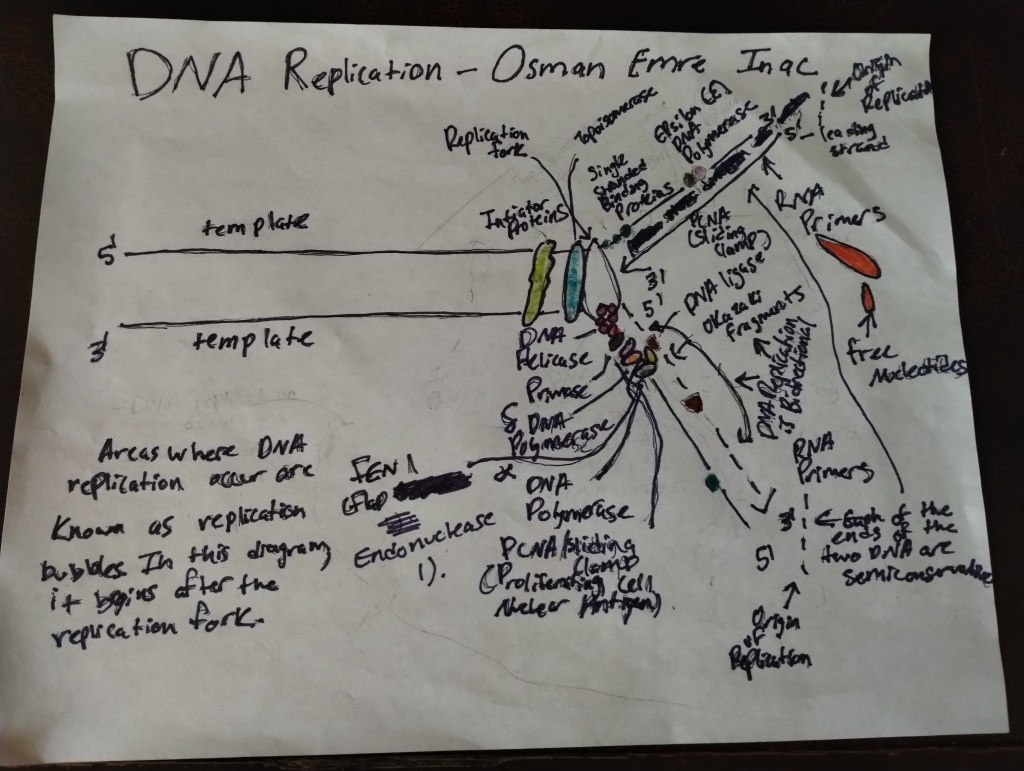
Critical Reading Assignment #1 – DNA Replication
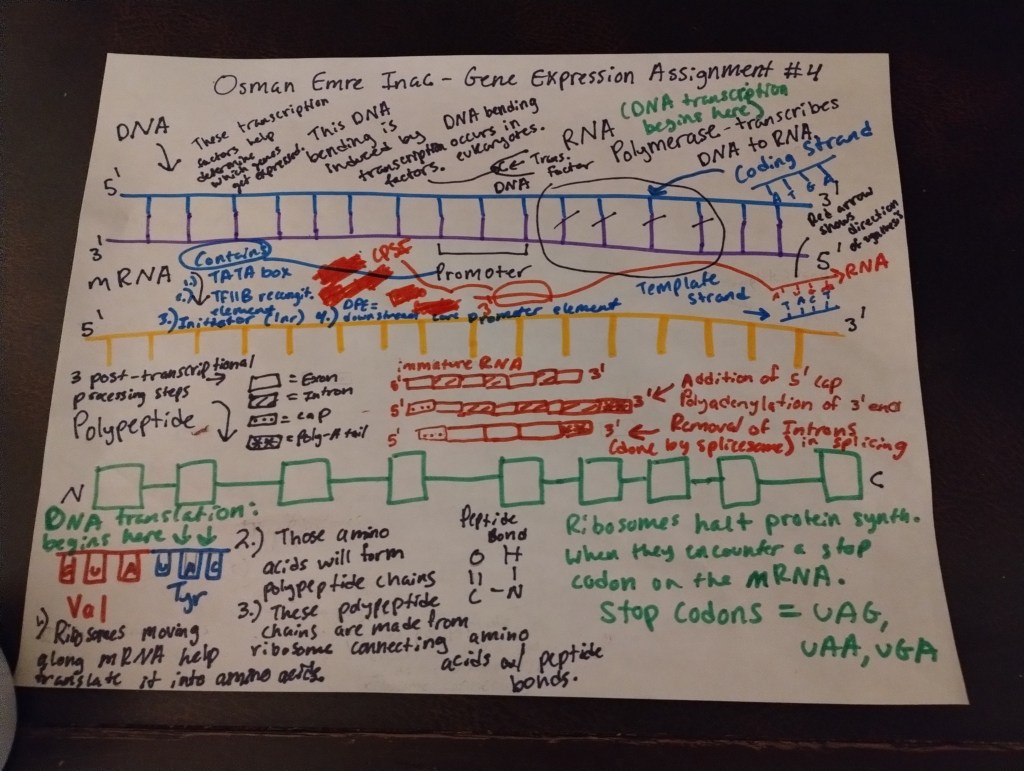
Critical Reading Assignment #2 – Gene Expression
 Becoming Dr. Osman Inac